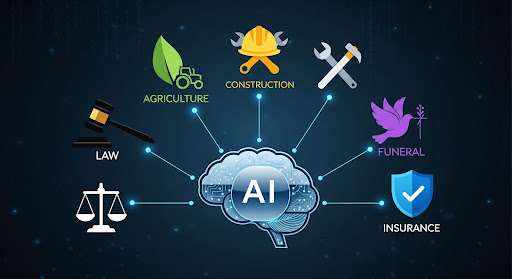

From funeral homes to farming — artificial intelligence is quietly reshaping the sectors that have resisted change the longest.
Change doesn’t come easily to every industry. Some sectors — think agriculture, legal services, funeral care, and construction — have operated the same way for decades, even centuries. These “conservative industries” aren’t conservative in a political sense. They’re conservative in the way they approach change: slowly, carefully, and often reluctantly.
But something interesting is happening right now. Digitalization and artificial intelligence are finding their way into even the most tradition-bound fields. And they’re not just adding a fresh coat of paint — they’re fundamentally changing how work gets done, how customers are served, and how businesses survive.
So how exactly is AI disrupting industries that have long resisted disruption? Let’s break it down into seven key areas where the transformation is already underway.
1. Agriculture: From Gut Instinct to Data-Driven Harvests
Farming is one of humanity’s oldest professions. For thousands of years, farmers relied on experience, intuition, and the weather forecast pinned to the barn wall. Today? AI-powered drones fly over fields, sensors monitor soil moisture in real time, and machine learning algorithms predict crop yields weeks before harvest.
What’s Actually Changing?
Precision agriculture is the umbrella term for this shift. Instead of treating an entire 500-acre field the same way, farmers can now manage it meter by meter. AI analyzes satellite imagery, weather data, and soil samples to recommend exactly where to plant, water, and fertilize.
The differences between traditional and AI-assisted farming are striking. Where farmers once monitored crops by walking the fields and relying on visual inspection, they now use drone imagery powered by computer vision. Pest detection used to happen only after visible damage appeared — today, sensor alerts catch infestations early, before they spread. Irrigation has shifted from set schedules and manual judgment to automated systems that respond to real-time soil moisture data. Yield predictions, once rough estimates based on experience, now come from machine learning models with 90% or better accuracy. And resource usage — water, fertilizer, pesticides — has gone from the “better safe than sorry” approach to precisely optimized applications that can reduce waste by up to 30%.
2. The Funeral Industry: Honoring Life with Digital Tools
If there’s one industry people assume will never change, it’s funeral care. Death and grief are deeply personal, deeply human experiences. The idea of “disrupting” them with technology might even feel disrespectful at first glance.
But here’s the thing — technology isn’t replacing the human side of funeral care. It’s removing the burdens that get in the way of it.
One of the most meaningful — and often most stressful — tasks a grieving family faces is writing an obituary. You’re dealing with raw emotion, time pressure, and the weight of capturing someone’s entire life in a few hundred words. Many people simply don’t know where to begin.
That’s where the online obituary writer comes in.
Traditional obituary writing typically involves one of two painful options: either you struggle through it yourself during one of the hardest moments of your life, or you pay a funeral home or newspaper to write something generic using a basic obituary template. Neither option does justice to the person you’ve lost.
FuneralFolio’s obituary writer takes a completely different approach. It uses AI to guide you through the process step by step, asking thoughtful questions about your loved one — their personality, their passions, the stories that made them who they were. In just a few clicks, it generates a personalized, heartfelt obituary that actually sounds like the person it’s about.
3. Legal Services: AI That Reads the Fine Print
The legal profession has traditionally been one of the slowest to adopt new technology. Paper files, manual research, billable hours — the system wasn’t exactly incentivized to move faster.
But AI is changing the economics of legal work in ways that benefit both lawyers and their clients.
What’s AI Doing in Law?
- Contract review and analysis: AI tools can scan hundreds of pages of contracts in minutes, flagging risks, inconsistencies, and unusual clauses that a human reviewer might miss after hours of reading.
- Legal research: What once required a junior associate to spend days in a law library can now be accomplished in minutes by AI systems that search case law, statutes, and legal opinions.
- Document automation: Routine documents — NDAs, wills, lease agreements — can be generated using intelligent templates that adapt to specific circumstances.
- Predictive analytics: Some AI tools analyze historical case data to predict likely outcomes, helping lawyers advise clients more accurately.
Is AI replacing lawyers? No. But it’s replacing the tedious parts of being a lawyer, freeing up professionals to focus on strategy, advocacy, and the human judgment that machines can’t replicate.
The firms that adopt these tools aren’t just saving time. They’re making legal services more accessible to people and businesses who couldn’t previously afford them.
4. Construction: Building Smarter, Safer, and Faster
Construction is another industry famous for its resistance to change. As recently as 2020, the construction sector was among the least digitized industries in the world, according to McKinsey research. That’s changing — fast.
Where AI Shows Up on the Job Site
Project planning and scheduling: AI algorithms analyze historical project data to create more accurate timelines, anticipate delays, and optimize resource allocation. Think of it as a project manager that never forgets a lesson learned.
Safety monitoring: Computer vision systems mounted on job sites can identify safety hazards in real time — a worker without a hard hat, equipment in the wrong zone, or structural risks that are invisible to the human eye. Some systems can predict accident-prone conditions before incidents occur.
Quality control: Drones equipped with AI scan completed work against blueprints, flagging deviations before they become expensive rework. This is particularly valuable in large-scale commercial and infrastructure projects where errors compound quickly.
Generative design: AI can generate thousands of design alternatives based on constraints — budget, materials, building codes, environmental impact — and identify optimal solutions that human designers might never consider.
5. Insurance: From Paperwork Mountains to Instant Decisions
Insurance might be the poster child for “industries that love paperwork.” Filing a claim traditionally meant filling out forms, waiting for an adjuster, submitting documentation, and then waiting some more. It could take weeks or even months.
AI is compressing that timeline dramatically.
Claims processing: AI-powered systems can evaluate damage from photos, cross-reference policy details, and approve straightforward claims in hours rather than weeks. Some auto insurers now process fender-bender claims almost instantly using image recognition.
Underwriting: Machine learning models analyze vast datasets — driving history, health records, property data, weather patterns — to assess risk more accurately and price policies more fairly.
Fraud detection: AI excels at spotting patterns that suggest fraudulent claims. It can analyze thousands of variables simultaneously, identifying anomalies that would take human investigators weeks to uncover.
Customer service: AI chatbots and virtual assistants handle routine inquiries 24/7, from policy questions to claim status updates. This frees up human agents for complex cases that require empathy and nuanced judgment.
6. Healthcare: AI at the Bedside (and Behind the Scenes)
Healthcare sits in an interesting spot. It’s simultaneously one of the most innovative and most bureaucratic industries in the world. Cutting-edge treatments coexist with fax machines and paper charts.
AI is attacking that contradiction from multiple angles.
AI algorithms can analyze medical images — X-rays, MRIs, CT scans — with remarkable accuracy. In some studies, AI has matched or exceeded radiologists in detecting conditions like breast cancer, lung nodules, and diabetic retinopathy. This doesn’t replace doctors. It gives them a powerful second opinion that catches what human eyes might miss.
Here’s a statistic that might surprise you: physicians spend roughly two hours on paperwork for every one hour of patient care. AI-powered documentation tools — including clinical note assistants and automated coding systems — are working to flip that ratio.
AI can analyze a patient’s genetic profile, medical history, and lifestyle data to recommend treatments tailored specifically to them — a field known as precision medicine. Instead of “this drug works for most people,” the approach becomes “this treatment is likely to work best for you.”
The shift is happening across every dimension of care. In diagnostics, the traditional model of a doctor’s assessment plus standard tests is being augmented by AI-assisted imaging analysis that serves as a tireless second set of eyes. Documentation — where manual charting eats up two hours for every hour of patient care — is being cut by more than half with AI-powered medical scribes. Drug development, historically a 10–15 year journey costing upwards of $2 billion, is seeing compressed timelines and reduced costs thanks to AI-accelerated molecular modeling. And treatment plans are evolving from population-based guidelines to personalized recommendations shaped by each patient’s unique genetic and lifestyle data.
The transformation in healthcare isn’t just about efficiency. It’s about saving lives. Early detection, reduced errors, faster drug development, and more targeted treatments — these improvements have real human consequences.
7. Real Estate: From Handshake Deals to Algorithm-Driven Markets
Real estate has long operated on relationships, local knowledge, and gut instinct. “Location, location, location” was about as data-driven as things got for most of the industry’s history.
AI is adding a layer of analytical precision that the industry has never had before.
Automated valuation models (AVMs) powered by AI can assess property values by analyzing thousands of data points — comparable sales, neighborhood trends, school ratings, crime statistics, proximity to amenities, and even satellite imagery of property conditions. These models are increasingly accurate and dramatically faster than traditional appraisals.
AI algorithms analyze economic indicators, interest rate trends, demographic shifts, and local market data to predict where property values are headed. Investors and developers use these insights to make better-informed decisions about where and when to buy, sell, or build.
AI-powered virtual staging can transform empty rooms into beautifully furnished spaces in seconds. Virtual tour technology allows buyers to explore properties from anywhere in the world. These tools have gone from “nice to have” during the pandemic to “expected” in today’s market.
The mountain of paperwork involved in buying or selling a home — disclosures, inspections, title searches, mortgage documents — is increasingly being streamlined by AI-powered platforms that automate document preparation, flag missing items, and keep all parties aligned.
For buyers, sellers, and agents alike, AI is making real estate transactions faster, more transparent, and less stressful. The handshake still matters — but now it’s backed by data.
The Common Thread: AI Handles the Burden, Humans Provide the Heart
Across every industry we’ve discussed, the pattern is the same. AI isn’t replacing the core human element of the work. Farmers still know their land. Lawyers still advocate for their clients. Funeral directors still comfort grieving families. Doctors still make life-and-death decisions.
What AI is doing is removing the friction, the repetition, and the inefficiency that prevents professionals from doing their best work. The farmer doesn’t need to walk every row. The family doesn’t need to stare at a blank page when writing an obituary. The doctor doesn’t need to spend half their day typing notes.
That’s the real transformation: not replacing people, but freeing them to be more human in their work.